Dyslexia is more common than most people realize. Yet, dyslexia awareness is still so low that many kids aren’t diagnosed until late in elementary school, or they’re never diagnosed at all.
This blog post was originally sponsored by Microsoft Canada in October 2020 for Dyslexia Awareness Month. We continue to update it to raise awareness and share resources to help parents and educators support students with Dyslexia.

Dyslexia Awareness
Dyslexia is shockingly common.
Did you know that 1 in 5 students have a language based learning disability? Dyslexia is the most common learning disability affecting students.
The exact percentage of people with Dyslexia still seems to be up for debate amongst researchers. But according to Understood.org, “Some experts believe that between 5 and 10 percent of people have it. Others say as many as 17 percent of people show signs of reading challenges.”
The International Dyslexia Association of Ontario explains the difference in statistics is due to the range in criteria for diagnosing Dyslexia.
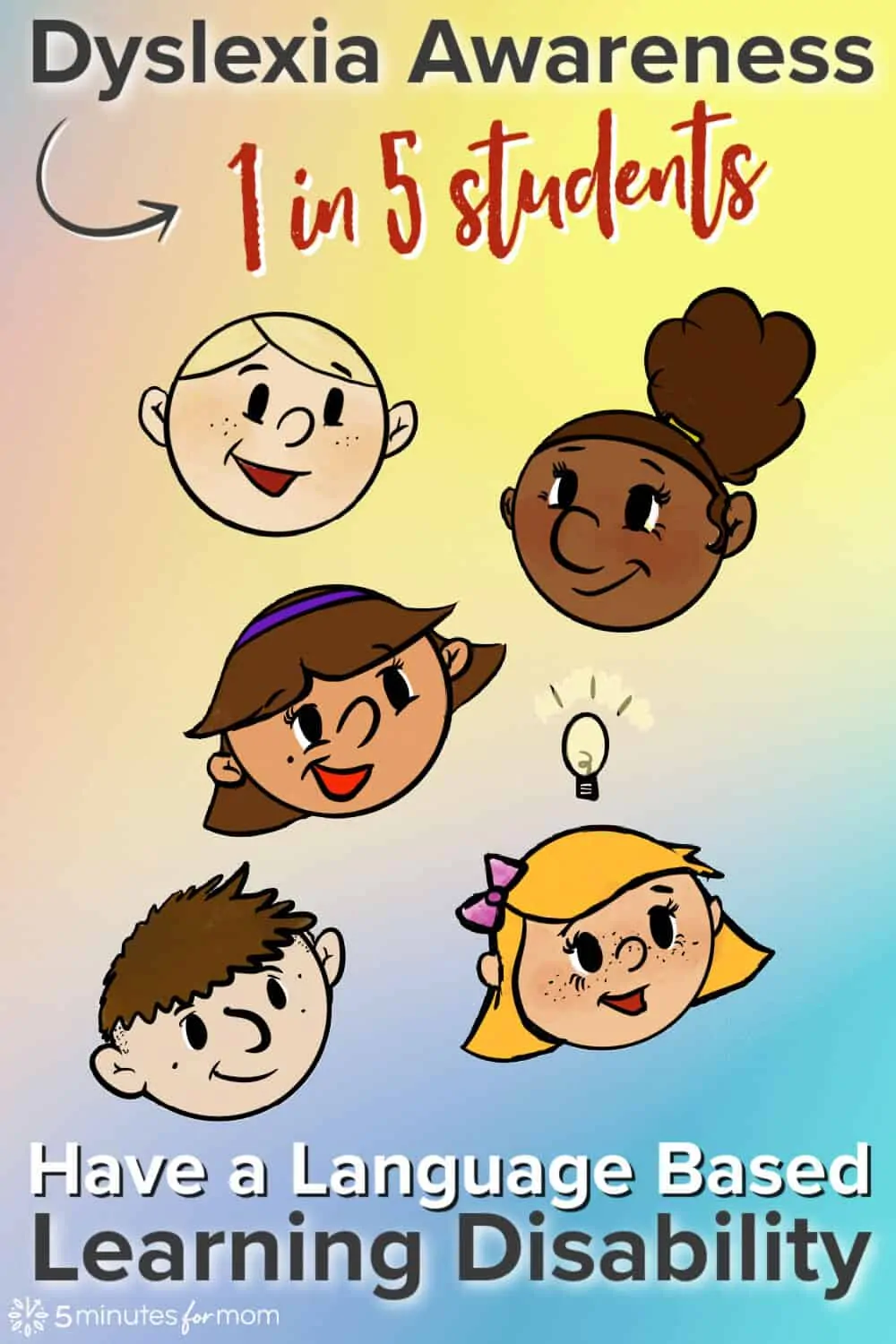 (Fun Fact: My 14-year-old daughter with Dyslexia and Dysgraphia drew these cute cartoon kids.)
If you aren’t yet familiar with the facts of Dyslexia, visit the IDA Ontario website for an excellent explanation of Dyslexia.
Dyslexia affects 5 to 20% of the population and is the most common cause of difficulties with learning to read, write and spell. It is a hereditary, neurological condition.
The International Dyslexia Association
There are many misconceptions about what Dyslexia is… and sadly, that misunderstanding has serious, negative consequences for students.
Our Story
I am passionate about spreading awareness of Dyslexia and other learning differences because I watched helplessly as my own children struggled to learn to read and started to hate school.
My younger daughter has Dyslexia and my older daughter has ADHD as well as Dyslexia and Dysgraphia.
The process of discovering their challenges, getting their diagnoses, and implementing educational adaptations has been a long and unnecessarily complicated road.
Like many other parents, I didn’t understand why my children were struggling to learn to read. I didn’t understand the science of reading, and my children suffered because I didn’t know how to help them.
Eventually, my girls were both diagnosed with specific learning disabilities in reading and writing.
The term Dyslexia is unfortunately not currently used by the education system in British Columbia, but I still choose to say Dyslexia.
The Diagnostic and Statistical Manual of Mental Disorders (DSM), which is published by the American Psychiatric Association (APA), uses the diagnostic term specific learning disorder (SLD) but it also says the term “Dyslexia” continues to be used to refer “specifically to difficulties with accurate or fluent word recognition, poor spelling, and deficits in coding abilities.”
When my younger daughter was finally diagnosed at the end of grade five, I started paying for Orton Gillingham private tutoring for her. It was life changing but I struggled with guilt for not being able to afford more sessions or full-time private school. And I feel guilty for missing that opportunity for her older sister.
I don’t like to live in a world of regret, but it’s impossible for me not to think, “What if?”
- What if I’d recognized the early signs of Dyslexia?
- What if one of their teachers had recognized the early signs?
- What if once we had the diagnoses, the schools had the funding, the appropriate teaching methods, and had used technology for the best accommodations to support their learning?
It’s too late for my kids to get those early supports… but it has empowered me to want to do everything I can to help others.
Change Is Here
Even though we can’t go back in time to erase our mistakes, we can start to use our knowledge, resources, and technology to improve our students’ education.
There are tools that most parents and even teachers do not realize can completely alter the course of a student’s academic journey.
Until now, most teachers and parents have continued with typical classroom teaching methods, including outdated methods of teaching kids to read. But now, as more parents and teachers are learning about Structured Literacy teaching methods and accommodations such as text-to-speech software, there are more ways we can help our children.
So this is the perfect time to embrace new teaching methods and tools, including spreading awareness of Dyslexia and other learning differences.
We CAN change how we diagnose and support Dyslexia.
How to Help Students with Dyslexia
It’s important for parents and teachers to use everything technology has to offer to help students learn… especially students with Dyslexia and other learning differences.
These days, students need to read complex articles as they research online to write reports for various school subjects. Class sizes are growing and teachers have limited time for one-on-one attention with students, putting dyslexic students at an even bigger disadvantage than they were in previous generations.

So it is especially important for parents and teachers to be aware of the signs of Dyslexia and know how to help kids get the instruction and accommodations they need to succeed at school.
While accommodations such as voice-to-text can help many students complete projects with more independence, technology is not a replacement for remediation.
Students need to be taught with proven methods using the science of reading, but they can often also be shown how to use additional supports with technology.
Microsoft’s Immersive Reader can be a huge help for students with Dyslexia.
Watch this…
It’s important that we as parents and teachers master the full power of Microsoft Learning Tools, including Immersive Reader, so that we create a more accessible, inclusive learning environment for all students.
If you’re a parent, empower yourself and your child with these tools now. Hopefully soon more teachers will learn how to use all of this software, but you don’t need to wait. If you can teach your own child how to use Immersive Reader, they can even show their teacher.
The IDA says, “While Dyslexia can make reading more difficult, with the right instruction, almost all individuals with Dyslexia can learn to read.”
But voice-to-text and text-to-voice tools can be critical for getting students the support they need. The key is students need to be shown explicitly how to use these tools. If your child is struggling to keep up in class, consider talking to their teacher about how to put more support in place in their classroom.
Tell Us…
We would LOVE to hear from you!
Do you have a child with Dyslexia or other learning differences? Have you used Microsoft Learning Tools or other assistive technology before? Do you think your child would benefit from Immersive Reader?
Please leave us a comment and let us know…
Share With Your Friends
We want to spread Dyslexia awareness and help more parents and teachers discover these tools. We’d love, love, love a tweet or a pin… Thanks so much! 🙂
Written by Susan Carraretto, co-founder of 5 Minutes for Mom
Talk with me: @5minutesformom and Facebook.com/5minutesformom
Pin with me at pinterest.com/5minutesformom
More Ways To Help Kids Learn
Find more of our tips to help kids learn…